Bardamu leaves Rancy
Journey to the End of the NightBardamu leaves Rancy in a quiet flight from poverty, illness, and the social injuries he expects to recur wherever he settles. The departure carries him toward Paris, but offers no promise of escape from misery: as he slips out unseen, the city’s night becomes both a route away and an image of the anonymity into which he believes he is disappearing.
Causes and Decision
The move begins with a failed season. After Robinson leaves Rancy, Bardamu expects his medical practice to improve, but unemployment has reduced the number of patients, and unusually mild, dry winter weather brings no epidemics. Even his colleagues make rounds on foot to spare their cars. Bardamu has only a raincoat for the weather; he wonders whether his persistent cold comes from that, from eating too little, or from the return of his fevers. A cold snap arrives just before spring, and afterward he cannot stop coughing. One morning he is too sick to rise.
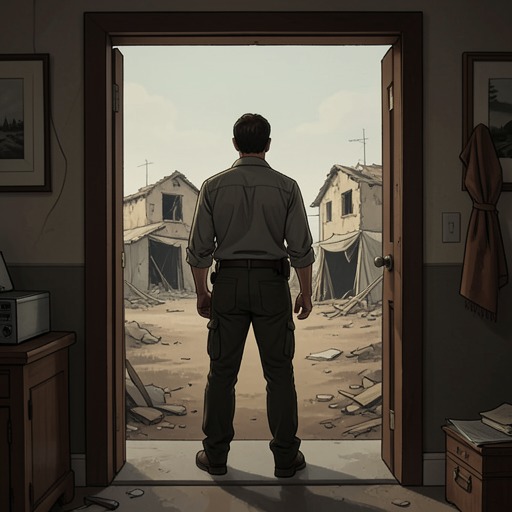
Bébert’s aunt happens to pass the house, and Bardamu sends her to collect the last small bill anyone owes him in the neighborhood. He receives only half of it, enough to keep him in bed for ten days. The episode makes his precarious position concrete: his final local income buys a brief spell of recovery, not security. He has also gone six months without paying rent. Lying ill, he decides to leave quietly, abandon his few pieces of furniture, and give nobody an address or explanation.
His plan rests on a wary calculation rather than faith in a better place. With a medical diploma, he can practice elsewhere, but he expects conditions eventually to turn just as hostile. A newcomer may have a few weeks of peace while people have not yet discovered how to exploit his vulnerabilities; then the familiar harm begins again. He regards departure as the only chance to delay that discovery, not to defeat it. His contempt for patients is equally unsparing: he expects the same weaknesses, appetites, boasting, and brutality in any neighborhood. A change of address cannot change human nature.
The Departure Through Rancy
Bardamu leaves his mezzanine lodging without telling anyone. At the concierge’s lodge, its occupants sit over wine and chestnuts. The woman scratches herself, while the man, bent over the stove and dulled by drink and heat, can scarcely keep his eyes open. Neither notices him pass. Bardamu counts their daughter as well as the adults among those who will no longer know where he is. The child is covered in festering sores from flea and bedbug bites; the lodge itself feels to him like a place one crawls into and comes out of scratched raw. Leaving means escaping not only rent and patients, but the scrutiny and petty injury of familiar neighbors.
The street briefly turns passers-by into silhouettes. A naked gas flame whistles in the entrance, its light making people appear gaunt or stout in the black doorway; under windows and streetlamps they recover some color, before dissolving again into the night. Bardamu no longer has any obligation to recognize them. He nevertheless wishes he could stop them for a moment and announce that he is going far away, beyond their power to hurt him. The impulse to speak is immediately undercut by the manner of his leaving: he gives no farewell to the street and no one a chance to answer.
At Boulevard de la Liberté, vegetable wagons are already bumping along the road to Paris, and Bardamu follows their direction. Cold, he detours to Bébert’s aunt’s lodging, although it takes him out of his way. The visit delays the departure he has chosen and gives it a human obligation the rest of his escape avoids. He tells himself that saying goodbye to her will make the break final.
Bébert’s Aunt and the Farewell
Bébert’s aunt wakes to find him there and first observes that he looks sick. She warns him that it is late for a walk toward Place Clichy and that the avenue is cold at night. Then she gets up, unsteady, and makes hot grog. As she talks, she returns chiefly to the Henrouilles and Bébert. Bardamu cannot redirect her from the dead boy. She arranges his remembered qualities like items in a display, determined not to omit one: she recounts even the details of bottle-feeding him as a baby, then starts again when another small quality comes to mind.
The effort to remember does not protect her from forgetting. Exhausted and wandering in thought, she loses track of what she has already recalled; when she realizes something is missing, she can only cry in frustration. She sobs herself to sleep. Bardamu watches her become still among the smells of the lodge, her attempt to hold Bébert’s small memories together overcome by fatigue. She has no one left on earth. In the scene, departure is shadowed by another, involuntary separation: the person Bardamu leaves behind is herself already close to loss.
A large school photograph of Bébert hangs above her sewing box. He appears in his smock, beret, and cross; the enlargement was paid for with coffee coupons. The modest, carefully obtained image gives the aunt’s work of remembrance a visible center. Bardamu imagines that her heart, already old and sick, will soon fail, and that she will be taken to the nearby cemetery where she once brought Bébert to play before his illness. Afterward, the lodge will be repainted. The prospect of ordinary repainting after death makes the farewell feel less like a dramatic rupture than a disappearance that the world will quietly cover over.
Escape, Fate, and the Night
Bardamu understands movement as a defense against a fate that cannot be escaped. A sick person changes sides in bed; people, too, can move from one side to another, and that is the only defense he believes they have found. But misery cannot be left behind along the road. He compares it to a dreadful wife one may as well learn to love a little, since beating her will not make it possible to kill her. His decision to leave Rancy therefore contains its own limit: he can move away from the immediate conditions that are crushing him, but he does not expect to be free of suffering.
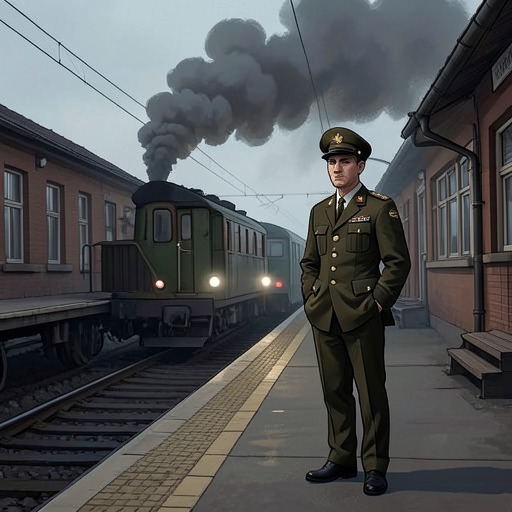
The departure’s final image is not arrival but passage. As Bardamu crosses the threshold of a new, unknown life, he pictures himself entering an endless tunnel. He passes the police station, where a patrolman spits while waiting to be relieved at midnight, and then sees the toll clerks bent over their enormous ledgers behind glass. The streetcars have stopped running. Beyond the toll station, the fortifications rise like shadowy piers, apparently waiting for ships from distant places that may never appear. The diploma in Bardamu’s pocket makes a larger bulge than his money and papers: his professional qualification remains tangible, but it cannot guarantee a livelihood or a home. The road to Paris offers movement, not resolution; the night receives him as one more dark, shapeless passer-by.